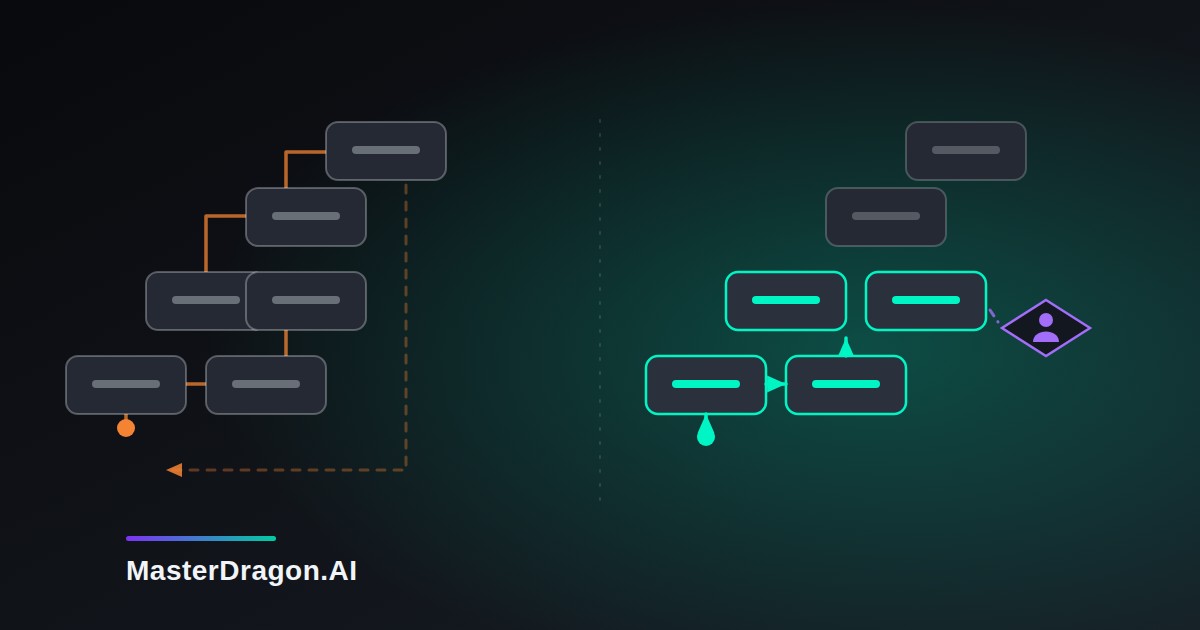


Almost every company that bought AI this year made the same investment: a good tool, on top of a process nobody touched. The workflow still has the same steps, the approval still climbs the same four levels, the dashboard still measures the same things, and the surprise arrives at the results meeting, when the impact is nowhere to be found.
The short answer: AI accelerates whatever exists. If what exists is yesterday's process, you bought speed for an old road. The group that does capture value is not using different models: it changed five things in the operating model, and none of the five is technology.
How narrow is the funnel really?
Much narrower than the adoption talk suggests, and the drop happens after the tool is in use.
It is worth laying out the real figures, because this data circulates in embellished versions. The State of AI survey, across 1,993 respondents in 105 countries, measures four steps [1].
Data
| Step | Organizations |
|---|---|
| Use AI regularly in at least one business function | 88% |
| Experimenting with or scaling agents | 62% |
| Report any EBIT impact | 39% |
| High performers: over 5% of EBIT attributed to AI | 6% |
The interesting drop is not between 0 and 88, which is the step everyone already climbed. It is between 88 and 39, and again between 39 and 6. There is no technology access problem there: everyone in the first bar already has it.
What does that 6% do differently?
They change the company, not just the tool. And one figure sums it up.
Data
| Group | Redesigned workflows |
|---|---|
| High performers (6%) | 50% |
| Everyone else | 17% |
Fifty against seventeen. This is not a budget gap or a scarce-talent gap: it is a willingness to move the work. And the same group is three times more likely to scale agents across functions and to have senior leadership genuinely pushing rather than sponsoring in name [1].
What are the five changes?
Five, and none of them can be bought. Each has a clear signal that you skipped it.
1. Redesign the workflow, do not accelerate it
Accelerating is asking the model to do step seven faster. Redesigning is asking whether step seven should exist. The honest test is counting: if the process had twelve steps before AI and has twelve after, you redesigned nothing. You bought a faster step.
Signal you skipped it: you can describe the improvement as a percentage of time, but you cannot name a step that disappeared.
2. Move decision rights toward the work
An agent that resolves a case in two seconds and then waits four days for someone senior enough to confirm it has resolved nothing: it moved the wait. If AI is going to operate at the edge, the authority to decide has to reach the edge with it.
Signal you skipped it: model response time dropped from minutes to seconds and total cycle time is unchanged.
3. Shorten approval paths, and keep only the irreversible ones
This is the one that gets done badly in both directions. Some leave every approval intact and kill the gain; others remove them all and discover the problem when an irreversible action ships unreviewed. The criterion is not amount or seniority, it is reversibility: what can be undone does not need a prior signature, what cannot does.
Signal you skipped it: nobody can name which action in the process is impossible to reverse.
4. Change the KPI before the tool
As long as a team is measured on activity volume, it will use AI to produce more activity. That is rational: it is optimizing what you asked for. This is the cheapest of the five changes and the one that reorders the other four on its own.
Signal you skipped it: the dashboard reviewed every Monday is exactly the one from before the project.
5. Move AI into core operations, not the lab
An AI center of excellence running off to one side, with its own budget and its own metrics, produces excellent demonstrations and zero change in operations. Two thirds of organizations still have not begun scaling AI at enterprise level [1], and this is a large part of why.
Signal you skipped it: AI use cases live in a deck separate from the operations review.
Where do you start when you cannot change everything?
With the fourth. It is the cheapest and it drags the rest along.
| Change | Political cost | Speed of effect | When to do it |
|---|---|---|---|
| Change the KPI | Low | Immediate | First, always |
| Redesign the workflow | Medium | One cycle | After baselining |
| Shorten approvals | Medium | Immediate | Alongside the workflow redesign |
| Move decision rights | High | One quarter | Once the new workflow works |
| Move AI into core ops | High | One year | Once two cases already run in operations |
Order matters more than speed. Moving decision rights before redesigning the workflow means distributing authority over a process that is going to change anyway, and it is the fastest way to spend political capital on something that undoes itself.
Does this mean cutting headcount?
Not automatically, and the data does not support that reading.
It is worth saying, because it is the first question in the room whenever operating-model redesign comes up. In the same survey, 32% expect workforce reductions, 43% expect no change and 13% expect increases, and most organizations hired for AI roles even while expecting automation [1].
What always changes is the job description: who decides, who reviews, who is accountable for the result. A redesign that does not touch that is not a redesign.
How we apply this at MasterDragon
We ask who signs before asking which model to use.
In practice, the first session of a project maps three things about the current process: where it waits, who approves, and which action would be impossible to reverse. That already tells us how much of the value will come from the model and how much from moving the decision, which is almost always the larger part and the one nobody budgeted.
We also ask for the new KPI before writing code. If the team cannot say which number will judge this in ninety days, the project is not ready to start, however good the idea is.
If you are about to invest in AI and want the result to show up in operations rather than only in the demo, talk to our engineers. You can start with how we build your software and review our portfolio of shipped AI-native products. Why using the tool is not enough we develop in adoption is not adaptation, what sits underneath an agent that survives production in the 13 layers of a real AI system, and how much autonomy to give each agent in engineered agency.
References
- McKinsey & Company. (2025, November 5). The state of AI: Agents, innovation, and transformation. Survey of 1,993 respondents across 105 countries. https://www.mckinsey.com/capabilities/quantumblack/our-insights/the-state-of-ai