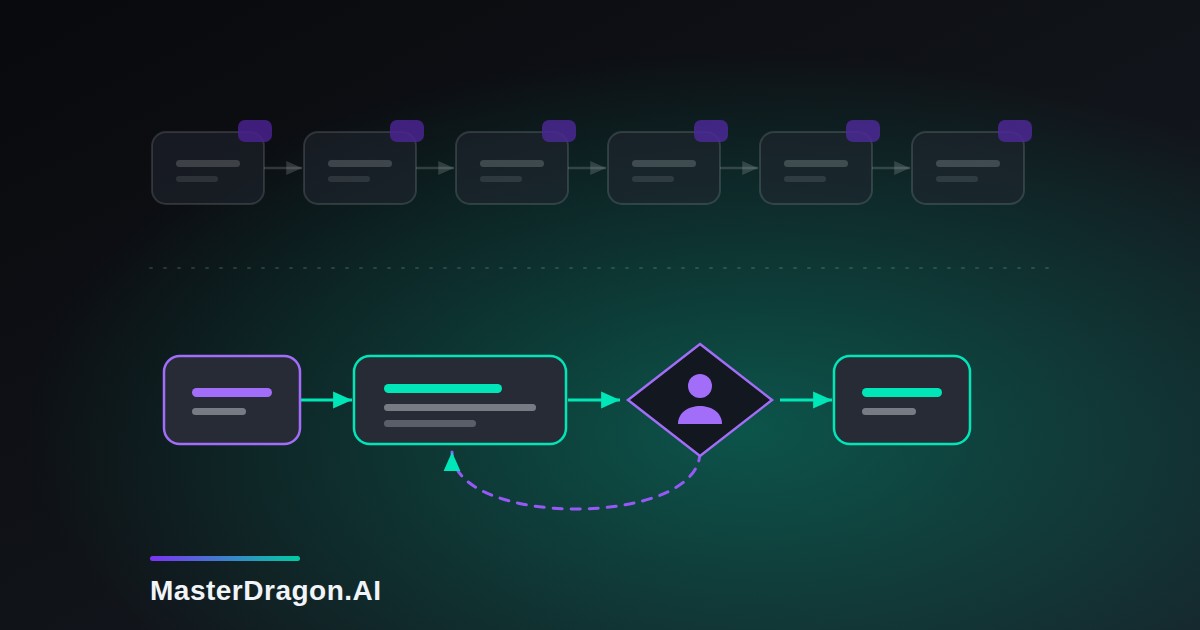


There is a scene that repeats in almost every company now reporting success with artificial intelligence. The usage dashboard shows excellent numbers: seats assigned, sessions per week, share of employees active. And next to it, the process still has the same twelve steps it had before, the same three approvals and the same delivery time. The tool reached every desk. The work never moved.
The short answer: adoption is easy to prove and easy to fake. It measures itself, it looks good in a steering committee, and it demands that nobody change a habit. Adaptation requires redesigning the work, which is why almost nobody measures it. The distance between the two is exactly the distance between your AI investment and your result.
What is the difference between adopting and adapting?
Adopting is the tool coming in. Adapting is the work coming out different.
The distinction looks semantic until it becomes budget. Adoption is measured with figures your vendor already hands you: active users, queries per day, features used. Adaptation is measured with figures only you can build: how many steps disappeared, how much cycle time dropped, which decisions changed owner.
An employee can open the tool, write a prompt, get a response, and then do exactly what they did before, only with a better-written paragraph. That counts as usage on any dashboard. It counts as nothing on the income statement.
How wide is the gap?
Wide, and it widens at every step.
Latin America solved much of the connectivity problem and almost none of the value problem. The Center for Latin America Convergence measured the three steps separately, and the result frames the conversation better than any digital transformation speech [3].
Data
| Step | Firms |
|---|---|
| Have high-speed broadband | 50% |
| Use artificial intelligence | 10% |
| Capture significant value | 6% |
Of every ten connected firms, two use AI. Of every ten that use it, six capture value. The most expensive loss is not at the first step, which absorbs all the infrastructure investment, but at the last one, which absorbs almost none.
Who is actually adapting?
One in six people who use AI. The figure shows up twice, measured by different routes.
Microsoft classified AI users by three observable behaviors: using agents for multi-step work, routinely redesigning workflows around what the model does well, and taking part in repeatable practices others can follow. Only 16% qualify [2]. Deloitte, asking from the organization's side rather than the individual's, found that 84% have not redesigned jobs or workflows around AI [1]. The complement is the same 16%.
Data
| Value | |
|---|---|
| Organizations that redesigned jobs and workflows | 16% |
| AI users who routinely redesign their workflow | 16% |
Two different methodologies, one by organization and one by individual, landing on the same number is the strongest signal of the year. This is not a sector problem or a country problem. It is the default way technology enters a company.
Which three behaviors separate one from the other?
Judgment, experimentation and divergent thinking. All three are human and none can be bought.
Judgment is knowing when to trust the model's output, when to challenge it and when to reject it. It is the scarcest behavior and the most expensive one to lack: only half of executives regularly verify the quality of what AI produces [1]. Without judgment, the model's speed becomes speed at propagating an error.
Experimentation is testing new ways to create value, not accelerating old ones. The practical difference: accelerating is asking the model to write the same report faster; experimenting is asking whether that report still needs to exist.
Divergent thinking is protecting your own idea from being absorbed into what the model already knows. A model returns the average of what exists. If your whole organization starts from that average, your competitive advantage converges on your competitor's, who uses the same model.
Why does the change management playbook no longer work?
Because it was designed for discrete waves of change, and this does not arrive in waves.
The classic playbook assumes an initial state, a transition project and a final state that stabilizes. AI offers no final state: the model you use today is not the one from six months ago. Only 27% of leaders say their organization manages change effectively [1], and that figure was measured against the old playbook, not against this demand.
The conditions data shows where it breaks.
Data
| Condition | Responses |
|---|---|
| Say they experiment with new ways of working | 78% |
| Report increased workload from the change | 69% |
| Feel recognized for adaptability | 56% |
| Executives who verify AI output quality | 50% |
| Cite lack of time as the main barrier | 43% |
Seventy-eight out of a hundred say they experiment, fifty-six feel that gets recognized, and sixty-nine report the change added workload rather than removing it [1]. An organization that demands adaptation, does not reward it, and charges its cost in hours is training its people to simulate adoption. And it will get exactly that.
Microsoft's most uncomfortable finding sits here too: 67% of the impact is explained by culture, managerial support and talent practices, against 32% attributable to individual capability [2]. Training people without changing the conditions attacks one third of the problem.
How do you measure adaptation instead of usage?
With work metrics, not licence metrics. Four of them work, and none ships in the vendor dashboard.
| What it measures | Adoption metric (easy) | Adaptation metric (useful) |
|---|---|---|
| Reach | Weekly active users | Steps removed from a real process |
| Speed | Queries per user | End-to-end cycle time |
| Quality | Satisfaction with the tool | Share of outputs reviewed and corrected |
| Durability | Seats renewed | New ways of working that survive a quarter |
The left column is what gets reported today because it arrives on its own. The right column requires a baseline before you start, which is exactly the step almost no pilot takes. MIT documented this across 300 deployments: 95% produced no measurable return, and the cause was not model quality but the learning gap, the inability to integrate it into the workflows, structures and culture that already existed [4].
One caveat about that figure: the MIT study rests on a small sample and its methodology has been challenged, so read it as a direction signal rather than a precise measurement. What larger studies do confirm is the underlying conclusion: organizations that redesign workflows and instrument a baseline do see returns, and those that only hand out licences do not.
How we apply this at MasterDragon
We measure the work before touching it, or we do not start.
In our projects that becomes a concrete sequence. First we baseline the process to be changed: how many steps it has, how long it takes end to end, where it waits. Then we define which step should stop existing, not which one gets accelerated. Next we make the human judgment point explicit in the design, with a name and an owner, instead of assuming someone will review. And at the close we measure the same process again with the same rule, so the improvement is comparable and not an impression.
The outcome we aim for is not that your team uses the tool. It is that in six months the process has fewer steps than today, and someone can point to which ones are gone.
If you are about to invest in AI and want that investment to show up in the result rather than only in the usage dashboard, talk to our engineers. You can start with how we build your software and review our portfolio of shipped AI-native products. If the next step is designing the system so it can be changed in parts, we develop that in composable enterprise architecture, and if the question is how much autonomy to give an agent, in engineered agency.
References
- Cantrell, S., Domergue, C., Dake, A., Murphy, J., Sundholm, T., & Gustafson, M. (2026, July 9). AI adoption to adaptation: How a new change approach can build the human behaviors needed for AI. Deloitte Insights. https://www.deloitte.com/us/en/insights/topics/talent/ai-adoption-to-ai-adaptation.html
- Microsoft. (2026). Work Trend Index Annual Report 2026: Frontier Firms and the new operating model. Microsoft WorkLab. https://www.microsoft.com/en-us/worklab/work-trend-index/agents-human-agency-and-the-opportunity-for-every-organization
- Center for Latin America Convergence. (2026, July). Unlocking the Digital Potential of Latin America and the Caribbean: Market Integration, Investment, Smart Regulation and Artificial Intelligence.
- Project NANDA, Massachusetts Institute of Technology. (2025). The GenAI Divide: State of AI in Business 2025.