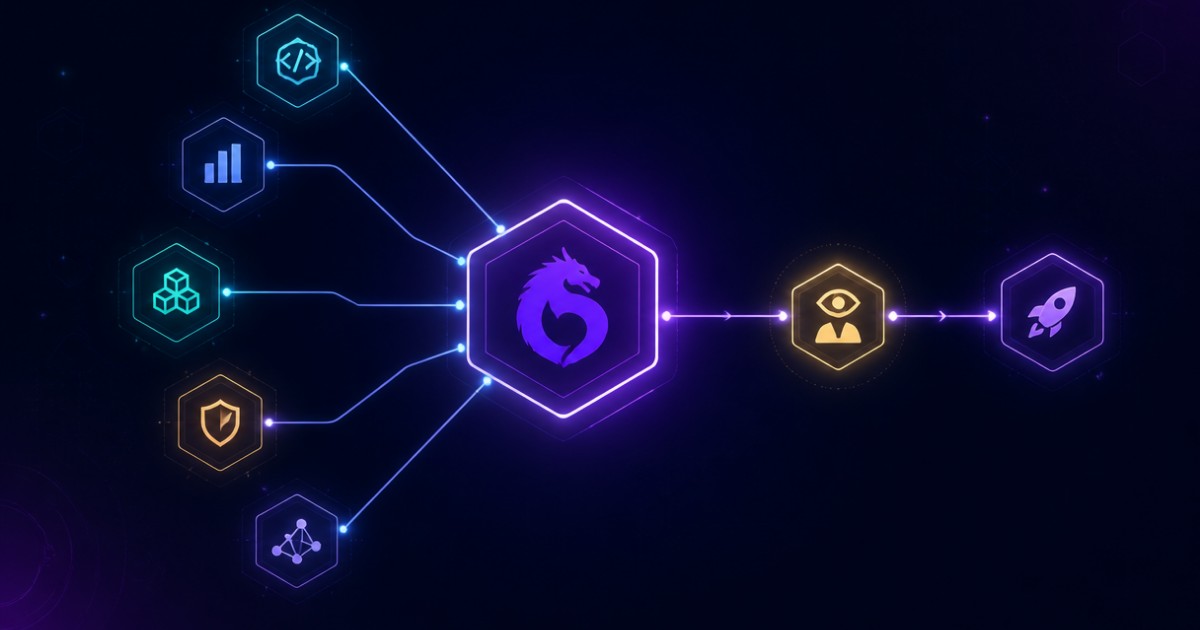


Almost every enterprise is now building with AI agents. Most will not get them to production. In McKinsey's 2025 global survey, 88% of organizations already use AI in at least one business function, yet no more than 10% have scaled agents in any single function, and only 39% report earnings impact at the enterprise level [1]. The gap is not ambition. It is reliability. This article explains how the strongest teams close that gap with a discipline we call Engineered Agency, and how we apply it in our own builds at MasterDragon.
The short answer: Agentic AI systems work when autonomy is earned, not granted. The best teams hold agents to a measured reliability threshold, run them from a central orchestrator instead of a loose swarm, instrument every step with evals and observability, and keep humans at the exception and approval points. Autonomy widens only as the evidence allows.
The agentic AI adoption gap is real
Adoption is wide. Results are thin. That is the defining tension of agentic AI in 2026.
Here is what the data shows: McKinsey reports that 62% of organizations are at least experimenting with AI agents, and 23% are scaling an agentic system somewhere in the business, while enterprise-wide impact stays rare [1]. Deloitte finds that 74% of leaders expect to use AI agents at least moderately by 2027, yet only 21% have a mature governance model for them [2]. Stanford's 2026 AI Index is blunter still: AI agent deployment sits in the single digits across nearly every business function [3].
The pattern holds across all three sources (see FIG-1). Companies can start an agent pilot. Far fewer can make one dependable enough to trust with real work.
Data
| Stage of adoption | Share of organizations |
|---|---|
| Use AI in at least one business function | 88% |
| At least experimenting with AI agents | 62% |
| Scaling an agentic system somewhere in the enterprise | 23% |
| Reporting enterprise-level EBIT impact | 39% |
| Scaled agents in any single function (10% or less) | 10% |
Why agentic AI systems break in production
The failure is structural, not a matter of picking a better model.
Gartner predicts that over 40% of agentic AI projects will be canceled by the end of 2027, citing escalating costs, unclear business value, and inadequate risk controls [4]. Gartner Senior Director Analyst Anushree Verma describes most current efforts as "early stage experiments or proof of concepts that are mostly driven by hype and are often misapplied" [4].
The research community has now measured why. A 2025 study from UC Berkeley analyzed 1,642 execution traces across seven multi-agent frameworks and built a taxonomy of 14 distinct failure modes, with observed failure rates between 41% and 86.7% [5]. Most failures traced back to specification gaps and misalignment between agents, not raw model weakness. The authors conclude that "improvements in the base model capabilities will be insufficient to address the full taxonomy" [5].
Single-shot demos hide this. The tau-bench benchmark shows that agents which look strong on one attempt collapse under repetition: a leading function-calling model passed a retail task about 61% of the time on a single try, but its success across eight consecutive attempts fell below 25% [6]. Consistency, not peak capability, is the real bar for production.
The reliability math executives miss
There is a simple equation behind most agent failures.
Chain several steps together and their error rates compound. The math is elementary: if each step in a workflow succeeds 99% of the time, a 10 step chain succeeds about 90.4% of the time, and a 100 step chain only 36.6% of the time. Push per-step accuracy to 99.9% and the same 100 step chain still tops out near 90.5%. FIG-2 plots that decline.
Data
| Steps in chain | 99% per-step accuracy | 99.9% per-step accuracy |
|---|---|---|
| 1 | 99% | 99.9% |
| 10 | 90.4% | 99% |
| 50 | 60.5% | 95.1% |
| 100 | 36.6% | 90.5% |
What this means in practice: long, fully autonomous chains are fragile by construction. The fix is not a bigger model. It is shorter autonomous spans, verification between steps, and a human at the points where a wrong decision is expensive. The empirical work above confirms the pattern in real systems [5][6].
Engineered Agency: autonomy you earn, not grant
This is where our position differs from the hype.
The market treats autonomy as a feature to maximize. We treat it as a privilege a system earns through evidence. We call this Engineered Agency: you grant an agent only as much independence as its measured reliability justifies, and you widen that scope as the data improves. The destination matches what McKinsey calls the symbiotic enterprise, a model in which "humans, AI agents, and intelligent robots each contribute according to their respective strengths" [7]. Our contribution is the engineering discipline that gets there safely.
The best builders already work this way. Anthropic's guidance to engineers is explicit: "the most successful implementations use simple, composable patterns rather than complex frameworks," and teams should add complexity "only when it demonstrably improves outcomes" [8]. Andrew Ng, founder of DeepLearning.AI, has argued that "AI agentic workflows will drive massive AI progress this year, perhaps even more than the next generation of foundation models" [9]. His own demonstrations make the point concrete: an older model wrapped in an agent loop reached 95.1% on a coding benchmark, against 48.1% for the same model prompted directly [9]. The engineering around the model often matters more than the model itself.
Engineered Agency rests on four disciplines.
Discipline 1: Set a reliability threshold before widening autonomy
Decide what "reliable enough" means before you ship, and measure it the hard way.
A single successful run proves nothing, as tau-bench demonstrates [6]. We define a target success rate over repeated trials for each task an agent will own, and we hold the agent below full autonomy until it clears that bar. Low-stakes, reversible tasks earn autonomy quickly. High-stakes, irreversible ones stay supervised much longer.
Discipline 2: Orchestrate centrally, not as a swarm
Coordination is where multi-agent systems fail, so we design coordination first.
Because misalignment between agents is a leading failure source [5], we favor a central orchestrator that decomposes a task, routes each part to a specialized agent, and verifies the result, over a loose swarm improvising together. This mirrors the composable, controlled patterns Anthropic recommends, and it avoids the emergent chaos of unconstrained agent-to-agent chatter [8].
Discipline 3: Make agents observable, then optimize
You cannot fix what you cannot see.
Every agent action in our systems is traced, logged, and scored against evals that run continuously, not just at launch. The 14 mode failure taxonomy from the Berkeley study doubles as a diagnostic checklist: it turns a vague "the agent broke" report into a specific, fixable signature [5]. Observability is what converts a fragile pilot into a system you can improve on a schedule.
Discipline 4: Put humans at the exception and approval points
The human role does not disappear. It moves up.
In the symbiotic model, humans set strategy, arbitrate exceptions, and exercise judgment on agent output, while agents carry the cognitive workload [7]. Anu Madgavkar, a partner at the McKinsey Global Institute, puts it plainly: "we shouldn't lose sight of the fact that human beings are vital. Almost half of that work is beyond the capabilities of today's technology" [10]. The new human work, she adds, is to "guide, prompt, validate, refine, or build on what AI is doing" [10].
Klarna shows the cost of forgetting this. Its AI assistant handled two-thirds of customer service chats within a month of launch, did the work of 700 agents, and cut resolution time from 11 minutes to under 2 [11]. Yet by 2025 the company was rehiring people for service after quality slipped, with its CEO conceding that a cost-only approach yields "lower quality" [12]. The takeaway is not that agents underdeliver. It is that the human checkpoint is what makes their output trustworthy at scale.
Humans, agents, and robots: dividing work by strength
The symbiotic enterprise is a division of labor, not a contest.
McKinsey's framework, echoed in its Global Institute research, gives each participant the work it does best [7][13]. Table 1 summarizes how we apply that split when we design a system.
Table 1. Dividing work by strength in an agentic system. Source: adapted from McKinsey [7][13].
| Dimension | Humans | AI agents | Intelligent robots |
|---|---|---|---|
| Core strength | Strategy, judgment, creativity, trust | Autonomous cognitive execution at scale | Physical work beyond human limits |
| Best at | Setting priorities, ethics, accountability, exception arbitration | Multistep workflows, applying enterprise skills, tool use | Acting in the physical world, generating operational data |
| Main limitation | Speed and volume of routine cognitive work | Judgment on novel exceptions, long-horizon reliability | High-level planning, safety overrides |
| Role in the model | Govern, decide, and oversee | Execute and orchestrate cognitive work | Execute and adapt physical work |
McKinsey estimates that redesigning workflows around people, agents, and robots together could unlock about $2.9 trillion of economic value in the United States by 2030, but only for organizations that "redesign workflows, rather than individual tasks" [13]. That qualifier is the whole game. Bolt-on AI automates a task inside an old process. AI-native systems rebuild the process around the new division of labor.
How MasterDragon builds agentic AI systems
We build AI-native, which means we redesign the workflow before we automate it.
In our deployments, that becomes a consistent method:
- Start from the workflow, not the model. We map where humans, agents, and tools each add the most value, then design the orchestration around that map.
- Build on API-enabled systems and clean data. Agents are only as good as the tools and context they can reach.
- Write evals before we widen autonomy. Every task an agent owns gets a measurable success bar and a repeated-trial test, per Discipline 1.
- Orchestrate centrally and verify each step. A controller decomposes, routes, and checks, per Discipline 2.
- Instrument everything. Tracing, logging, and continuous evals keep the system improvable, per Discipline 3.
- Keep humans at the exceptions. Approval and exception handling stay with people wherever a decision carries real cost, per Discipline 4.
This is slower than wiring up a swarm of agents and hoping. It is also how an agent reaches production and stays there.
The work ahead
The lesson of the last two years is not that agentic AI underdelivers. It is that the winners are not the organizations that deploy the most AI, but those that "reinvent their operating models fastest" and secure the points where intelligent execution creates value [7]. Reliable autonomy is engineered, one measured step at a time, with humans where judgment matters most.
That engineering is what we do. Talk to our AI engineers about your build, and we will help you design an agentic system that earns its autonomy and ships. Start with our portfolio of shipped AI-native products.
References
- McKinsey & Company. (2025, November 5). The state of AI in 2025: Agents, innovation, and transformation. https://www.mckinsey.com/capabilities/quantumblack/our-insights/the-state-of-ai
- Deloitte. (2025). State of AI in the enterprise (2026 edition). https://www.deloitte.com/us/en/what-we-do/capabilities/applied-artificial-intelligence/content/state-of-ai-in-the-enterprise.html
- Stanford Institute for Human-Centered AI. (2026). The 2026 AI Index report: Economy. https://hai.stanford.edu/ai-index/2026-ai-index-report/economy
- Gartner. (2025, June 25). Gartner predicts over 40% of agentic AI projects will be canceled by end of 2027. https://www.gartner.com/en/newsroom/press-releases/2025-06-25-gartner-predicts-over-40-percent-of-agentic-ai-projects-will-be-canceled-by-end-of-2027
- Cemri, M., Pan, M. Z., Yang, S., Agrawal, L. A., Chopra, B., Tiwari, R., Zou, J., Ramchandran, K., Sahai, A., Gonzalez, J. E., & Stoica, I. (2025). Why do multi-agent LLM systems fail? arXiv. https://doi.org/10.48550/arXiv.2503.13657
- Yao, S., Chen, H., Yang, J., & Narasimhan, K. (2024). tau-bench: A benchmark for tool-agent-user interaction in real-world domains. arXiv. https://arxiv.org/abs/2406.12045
- QuantumBlack, AI by McKinsey. (2026, June 16). The symbiotic enterprise: How cognitive and physical AI are reinventing enterprise execution. McKinsey & Company. https://www.mckinsey.com/capabilities/quantumblack/our-insights/the-symbiotic-enterprise
- Anthropic. (2024). Building effective AI agents. https://www.anthropic.com/research/building-effective-agents
- Ng, A. [@AndrewYNg]. (2024, March 21). Agentic workflows [Post]. X. https://x.com/AndrewYNg/status/1770897666702233815
- McKinsey & Company. (2026, April 30). The rise of the human-AI workforce [Audio podcast episode]. The McKinsey Podcast. https://www.mckinsey.com/capabilities/people-and-organizational-performance/our-insights/the-rise-of-the-human-ai-workforce
- Klarna. (2024, February 27). Klarna AI assistant handles two-thirds of customer service chats in its first month. https://www.klarna.com/international/press/klarna-ai-assistant-handles-two-thirds-of-customer-service-chats-in-its-first-month/
- Pereira, A. (2025, May 9). Klarna changes its AI tune and again recruits humans for customer service. Customer Experience Dive. https://www.customerexperiencedive.com/news/klarna-reinvests-human-talent-customer-service-AI-chatbot/747586/
- McKinsey Global Institute. (2025, November 25). Agents, robots, and us: Skill partnerships in the age of AI. McKinsey & Company. https://www.mckinsey.com/mgi/our-research/agents-robots-and-us-skill-partnerships-in-the-age-of-ai